
After more than two decades in clinical practice, one of the questions I hear most often from new patients is: “I’ve had every test done and everything came back normal — so why do I feel so terrible?”
It’s a frustrating place to be. And for many people, the answer lies not in what their blood tests showed, but in what those tests were never designed to measure in the first place.
This is where Hair Tissue Mineral Analysis (HTMA) changes everything.
What Is Hair Tissue Mineral Analysis?
Hair Tissue Mineral Analysis is a laboratory test that measures the mineral content of a small sample of hair — typically taken from the back of the scalp. Unlike blood, which reflects what is circulating in your body right now, hair records a cumulative picture of your body’s mineral status and toxic metal exposure over the past two to three months.
Think of it this way: a blood test is a snapshot. An HTMA is a time-lapse.
At the Homeopathic Plus Centre in Mississauga, I use HTMA through CanAlt Laboratories — a Canadian reference lab — and interpret results using clinical ranges developed specifically for holistic and functional health assessment.
Why Blood Tests Often Miss What HTMA Catches
Standard blood work is an essential tool, and I am not suggesting you stop getting it. But it has real structural limitations that most patients — and many practitioners — don’t fully appreciate.
1. Blood Mineral Levels Are Tightly Regulated
Your body works hard to maintain blood mineral levels within a narrow range, because significant deviations are immediately life-threatening. If calcium drops too low in the blood, your body will pull it from your bones to compensate. If magnesium is depleted at the cellular level, blood magnesium may still appear normal because the body has drawn from its reserves elsewhere.
This means blood tests can show “normal” results while your tissues are significantly deficient. HTMA reflects what is actually being deposited and used at the cellular level — where health and disease actually happen.
2. HTMA Reveals Intracellular Mineral Status
The minerals that run your metabolism — calcium, magnesium, sodium, potassium, zinc, copper, and others — work inside cells, not primarily in the bloodstream. HTMA gives us a window into intracellular mineral balance in a way that serum testing simply cannot.
In my practice, I regularly see patients with “normal” serum magnesium whose HTMA reveals clear magnesium insufficiency at the tissue level — often correlated with the fatigue, muscle tension, anxiety, and poor sleep they came to me with.
3. HTMA Maps Your Metabolic Type
One of the most clinically useful aspects of HTMA is what we call metabolic typing. Based on the ratios of the four major minerals — calcium, magnesium, sodium, and potassium — we can identify whether a person is in a fast oxidizer or slow oxidizer pattern. This tells us a great deal about how their adrenal and thyroid glands are functioning, how they are producing and burning energy, and what dietary approach will genuinely support them.
This is individualised medicine. Two people with the same symptoms can have completely opposite HTMA patterns — and therefore need completely different interventions.
4. HTMA Detects Toxic Heavy Metal Accumulation
Standard blood work is not a reliable screen for chronic heavy metal burden. Blood metals testing only captures acute, recent exposure — if you were exposed to mercury, lead, or arsenic months or years ago, it will not show up in blood.
Hair is metabolically active tissue. As it grows, minerals and metals are deposited into the hair shaft from the blood supply. This means HTMA can detect metals that have long since cleared from the bloodstream but remain stored in tissues — where they continue to interfere with enzyme function, hormonal signalling, and neurological health.
In my clinical work, I use a four-shield mercury protection framework and specific mineral ratios to assess toxic metal burden and guide safe, staged detoxification support.
5. HTMA Reveals Hidden Patterns Behind Chronic Symptoms
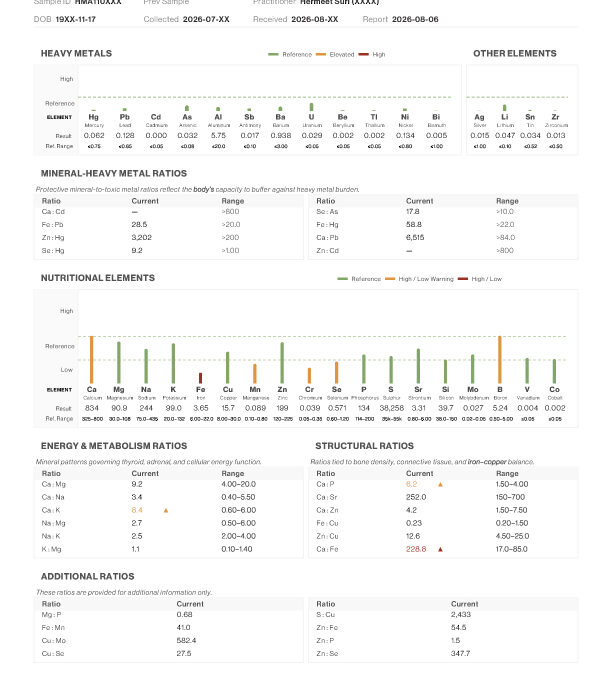
Some of the most important clinical findings in HTMA are not the individual mineral levels themselves, but the ratios between minerals. At HPC, I assess nine key mineral ratios that illuminate:
- Thyroid function (calcium-to-potassium ratio)
- Adrenal activity (sodium-to-magnesium ratio)
- Blood sugar regulation / Lifestyle (calcium-to-magnesium ratio)
- Vitality / Energy (sodium-to-potassium ratio)
- Mental / Hormonal balance (zinc-to-copper ratio)
- Oxidation Type (calcium-to-phosphorus ratio)
- Energy Expenditure (calcium-to-sodium ratio)
- Absorption (calcium-to-iron ratio)
- Infections / Cellular Respiration (iron-to-copper ratio)
These patterns help explain why a patient with normal TSH is still exhausted, or why someone with no diagnosed adrenal disorder is running on empty by 2 PM every day.
What HTMA Cannot Tell You
Clinical honesty matters. HTMA is a powerful screening and monitoring tool, but it is not a standalone diagnostic test. It does not replace blood work, and it is most valuable when interpreted by a practitioner who understands its clinical context and limitations — including the known variability in hair samples and the importance of correlating findings with symptoms and other investigations.
Sodium and potassium results in hair, for example, are known to be influenced by external factors including shampoo and water exposure, and I apply additional scrutiny before drawing conclusions from those markers alone.
Who Can Benefit From HTMA?
In my practice, HTMA is particularly valuable for patients dealing with:
- Chronic fatigue that blood tests haven’t explained
- Anxiety, mood instability, or difficulty concentrating
- Hormonal imbalances — including thyroid and adrenal dysfunction
- Hair loss or poor hair and nail quality
- Digestive problems including poor absorption
- Suspected heavy metal exposure (amalgam fillings, occupational exposure, environmental)
- Children with developmental or behavioural concerns
- Anyone who has “tried everything” and still doesn’t feel well
HTMA is also an excellent monitoring tool. After implementing a supplement protocol and dietary changes, a follow-up test at three to four months allows us to objectively track how the body is responding and adjust the plan accordingly.
How HTMA Works at the Homeopathic Plus Centre
The process is straightforward. A small hair sample (about a tablespoon, taken close to the scalp) is collected and sent to CanAlt Laboratories. Results typically return within two to three weeks.
From there, I prepare a comprehensive clinical analysis covering your metabolic type, first four minerals, heavy metal findings, key mineral ratios, hormonal and glandular implications, and a staged supplement protocol drawn from our in-clinic dispensary. Where appropriate, HTMA findings also inform the homeopathic case — particularly around miasmatic and constitutional patterns. Also, if there is a presence of a Calcium Shell which points to a trauma that was internalised and preventing the body from truly healing.
The goal is not to hand you a list of supplements. The goal is to understand you — your body’s particular terrain — and build a protocol that addresses the root of what you’re experiencing.
Ready to Learn What Your Hair Can Tell You?
If you’ve been told your tests are normal but you still don’t feel well, an HTMA may be the missing piece.
I offer both in-clinic and remote consultations across Canada. To book a complimentary 20-minute health discovery session or to inquire about HTMA testing, contact the Homeopathic Plus Centre:
📍 3115 Glen Erin Drive, Unit 8, Mississauga, ON L5L 1J3
📞 (416) 825-9289
✉️ info@homeopathicpluscentre.com
🌐 www.homeopathicpluscentre.com
Hermeet Singh Suri (Hom, BSc, RHN, Epigenetics) is a classical homeopath and registered holistic nutritionist with over 20 years of clinical experience. He practices at the Homeopathic Plus Centre in Mississauga, Ontario, and sees patients both in-clinic and remotely across North America.
Recent Comments